
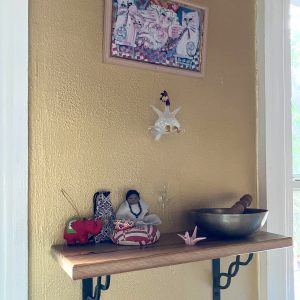
Many yogis, if they are to create a practice space for themselves, put together some sort of alter containing spiritual items important to them. They position the altar so that they can meditate and/or practice yoga positions directly in front of it. Ideally, the altar is placed in a way where they face east when they practice and meditate. This follows tradition.
No surprise, my yoga room is a bit unconventional.
The shape of my room, where the windows and doors are placed, the cardinal direction the room faces, and where I was able to install rigging for aerial yoga have all guided my personal practice. I actually wind up spreading my practice around the room depending on the activity. I meditate in a corner facing northeast, I practice hammock yoga facing west, I practice no-hammock yoga facing north, and even though my yoga items display shelf is the first thing one sees when entering the room, I do no activities in front of it.
Since yoga is my spiritual practice, I suppose my spiritual practice is literally all over the place.
When I googled “spiritual practice all over the place” just to see what would be presented, I came across an article written by Morgan Shipley, an associate professor of religious studies at Michigan State University.1 In this article written to help people find a new spiritual practice, Shipley breaks down the etymology of the word spirituality to its root, spiritus, which means, breath. As a yoga aficionado, I find this fascinating!
Yoga teachers always talk about the importance of the breath during the yoga postures class and of course during meditation. But what if paying attention to breath is equally important after the yoga class, after meditation? I suspect that would be a sign of enlightenment, and a worthy goal to strive for. But for many of us, it’s already a difficult enough challenge to pay attention to the breath during meditation while sitting still, literally doing nothing. To watch the breath all day long, during activities and conversations would be completely unachievable.
Lucky for us, there are many ways to practice spirituality; it doesn’t only have to be in the form of watching the breath. Shipley also gives a definition for “spiritual practice” that could work for people of all religious faiths including no religious faith:
“A routine practice that promotes wellbeing becomes spiritual when it is intended to advance your sense of self and cultivate connection to something greater than yourself such as a higher power, nature or other people.”
With this definition, we could turn many if not all our daily activities into a spiritual practice simply through our intention and attitude.
For example, my daily activities could simply be chores I need to do to keep myself alive. Or, I could perform those duties with the intention of taking care of nature and/or other people through the activity. Even though they are the same activities, they can be done selflessly, making them spiritual endeavors.
Attitude and perspective changes everything! Take my yoga room for another example: I could see the spread of spiritual activities and artifacts around my yoga room as a way of being undisciplined (all over the place). Or, I could see it as an outward expression of how spirituality could exist everywhere for me (all over, everywhere). I have the power to decide it either way.
And so do you! Your intention determines your purpose, even if you follow an unconventional route. The best place for your spiritual practice is anywhere and everywhere that makes sense to you. 🙂
1. How To Find New Spiritual Practices, written by Morgan Shipley
