
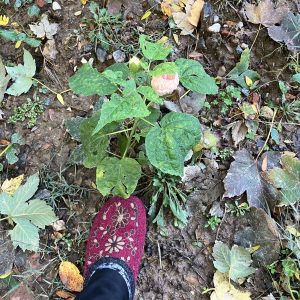
It’s now mid-autumn, the days are definitely shorter, and much of our summer garden is moving into hibernation mode.
As I was doing a bit of weeding and clearing, I noticed the tiny hibiscus growing.
We have two large hibiscus plants which bloom in early July, and produce pink flowers throughout the summer as large as your spread hand. I’m not a gardener, and so I find them quite magical.
But those beautiful gigantic plants are now done for the season. There is nothing left but dried, brown sticks where the stalks used to be. How is it that this tiny hibiscus is growing so late in the season?
It does not surprise me that the plant suddenly popped up in a random spot in the yard. That happens quite frequently, actually. Squirrels, birds, maybe even cats, opossums and wind all bring seeds and deposit them. And thanks to the verdant Pennsylvania land I live on, things here grow quite naturally, with very little work on my part.
But, doesn’t this hibiscus know that it’s natural growing season was over 2 months ago? It’s way too late to begin growing, let alone flowering.
It got me thinking of the different types of reactions people could have about the fate of this hibiscus.
- Some would consider it close to a miracle.
- Some would think the plant was brave, and cheer it on, “Go Hibiscus! Don’t let ‘the Nature’ tell you what you can and cannot do!”
- Some would say, “Oh, even though it’s life will be short, it is beautiful that the plant had a life at all.”
- Some would be sad for the plant, knowing that it’s going to have such a short life. They might even try to dig up the plant and pot it in something to bring indoors for the winter, to try and prolong it’s life.
- Some would think the plant was stupid or foolish to start growing this late in the year. At the first frost that will inevitably kill it they’d say, “Well, that’s what you get for trying to bloom so late.”
Which one of these attitudes is yours? Or perhaps, you have a different perspective I didn’t consider.
There are so many different attitudes a person can have towards events they see happen. In yoga, even the smallest observation can become a mirror for the mind. So from a yoga perspective, it is worth contemplating our attitudes, even on mundane events, out of the pursuit of svadhyaya (self-study).
Svadhyaya is the practice of inspecting the contents of our own mind, and comparing our experience with what ancient yoga guides tell us are best practices for a healthy and happy life. It is one of the niyamas, or ethical conducts associated with a yoga practice, along with honesty and refraining from violence, just to give you a couple examples.
Through practicing svadhyaya, we learn how our mind operates, and we start to recognize our habitual mental patterns which direct what we notice in the world, and influence our opinions toward what we witness. Our attitudes aren’t solely forged “in the moment” due to events in front of us. Rather, they are influenced by our viewpoint of how life works and how one should behave in various situations as taught by our religion, family, education and experiences, especially the traumatic ones.
For example, the person who has a distrust and distaste for authority figures and structures might be the one who cheers the hibiscus for it’s idiosyncrasy. The person who feels lonely might be the one who tries to bring the plant indoors to nurture it. When you practice svadhyaya, you are the one investigating the thoughts that arise for you, and you are also the one who most intimately knows your own history. Therefore, you are well-equipped to gain insights and guide your own self-growth and/or self-realization. The more you can “see” your automatic thoughts and attitudes, the less likely it is for them to stay automatic and seemingly immutable. You then stand a good chance to practice and adopt a different attitude you believe will be more helpful for you either in the moment, or the future.
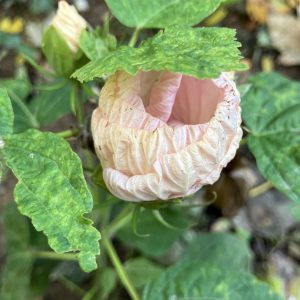
In the end, perhaps we can adopt an entirely different attitude towards the hibiscus – one of gratitude.
