
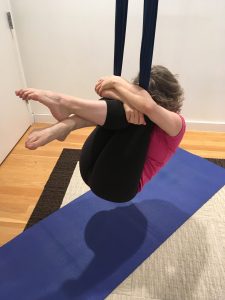
 I started the conversation trying to impress — listing my depth of education, the powerful and positive feedback I’ve received from students, and my extensive experience developing and teaching aerial yoga.
The studio owner replied that her teachers offer items people can learn for free on YouTube.
Listening to my 20 years of devotion, practice, development, research, and transmission of what has grown into a beautifully effective way to practice yoga being equated with something casually accessible was a tough thing to sit with. Imagine, for a moment, working on and refining a craft for 20 years, only to have its depth compared to someone just beginning.
After our conversation ended and I hung up the phone, I have to admit my throat tightened, my eyes filled with tears, and a quiet despondence set in.
I was frustrated by my inability to convince this person that my skills, and I, have value.
In times like these, I find it helpful to turn to yoga philosophy. And so, I looked to the Bhagavad Gita for insight.
(Chapter 2, lines 47–48, translation by Laurie L. Patton)
This passage is a steady reminder that no matter what actions we take, when we are motivated primarily by external reward or recognition, we move further from the state of yoga.
In other words, I can share the depth of my education and experience. I can teach and lead with as much integrity as I know how. But I cannot control how someone else understands the world, or how they perceive me or my work.
If I want to cultivate the inner steadiness yoga points toward, I must learn to be at peace with whatever response arises, even when that response is not particularly flattering.
And I also have to ask myself: in a time when we are encouraged to gather information quickly, who among us has not looked up a topic once — read one book, watched one video, done one Google search… and assumed we understood it?
Rather than trying to change someone else’s perspective, perhaps a different approach is to clearly see and remember how the Unnata method truly supports me and my students. On days when insecurity creeps in, I can return to the lived experience of its depth and effectiveness.
After all, how could someone else’s surface understanding replace my own multi-layered, lived understanding of what I do?
How about you?
Have you ever been, or are you currently, unsettled by someone else’s perception of you? What helps you return to equanimity?

One Response
Thank you for sharing this with us 🙏this is something that I think most of us teachers relate to❤️how can it be ? Since I started my yoga journey 2005 I have been learning. And what i thought then has changed several times in something new through the years. And will continue 😉that is the amazing thing about yoga. Like our bodies and minds we are all different on our beautiful ways and we feel and understand things on different ways. Some spirits connects and some dont. I am so happy that I met you and your amazing knowledge about all the limbs of yoga and the way you teach aerial yoga ❤️