
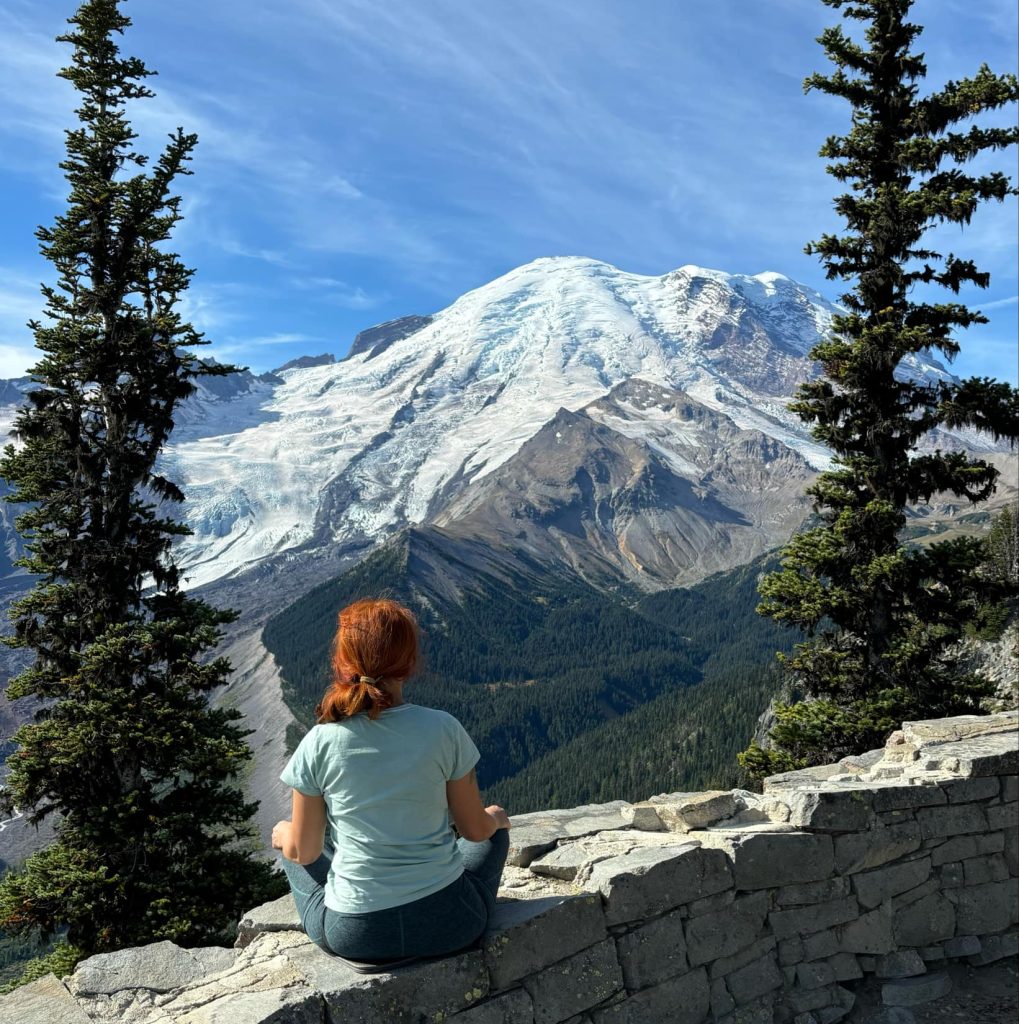
 My Instagram page describes me as a yoga teacher, but there are no photos or videos of me practicing yoga asanas. Rather, you’ll find mostly photos of mountains, lakes, forests and the sea. Washington State, where I live, is infinitely beautiful. And, I am grateful for the opportunity to see and experience this beauty; I always want to share it. Each trail, like every yoga class, is a small separate life that changes a person in some ways, and in some ways makes a person more themself.
For me and for many of my fellow teachers, a yoga practice is almost indistinguishable from an appreciation of natural beauty. But, how can we communicate this connection? I remember reading an expression in a small Facebook group called Not Enlightened In Seattle. It read, “Words are a bad translation from the original. Everything happens in a language that does not exist.” The meaning of the first phrase is quite obvious; it is clear that words are constructions and symbols that are a product of our mind. Everything that language can convey will always be at best close to the essence, but it will never be a complete reflection of it. The second sentence amuses me more, “Everything happens in a language that does not exist.” What kind of language is this that doesn’t exist? Although in fact it does exist, because everything happens in it. It seems to me that this sentence refers to the universal language of Nature. Or more specifically, the language of nature, yoga and soul. It is the language that existed long before humans appeared, and is the language of the world before the illusion of maya and its duality arose.
The philosophy of yoga says that duality arose with the appearance of the human ego, after God sent man to earth to receive the experience, to practice life. In response to the suffering that duality causes, yogis try to balance opposing qualities and unite them in order to achieve a third quality that consists of both the opposites. This third quality transcends the existence of the other two. For example, balancing the opposites of the right side and left side in each yoga class, we strive to find our center. By uniting right and left, we become aware of our body as a whole and can feel the movement of energy in it. By balancing another pair of opposites in our yoga practice: flexibility and strength, we strive to become “flexibly strong” such as a panther in whose body it is impossible to separate these qualities. In this union, flexibility and strength are no longer opposites, but are one. Flexibility and strength are both increased in unison.
The most important pair of opposites that we work with throughout our lives is the distinction between “me” and the universe (inside and outside). When we can find balance and unite our inner and outer world, we can truly achieve a state of Samadhi, a state in which there is no boundary between “I” and the universe. That is, “I am the world and the world is me.”
Let’s go back to our universal language of yoga, soul and nature. We somehow lost this language, but we always try to remember it, and through yoga much of this remembering is possible. I believe that there are four aspects of yoga that directly relate to our connection with and appreciation for the natural world: Subtle Energy; Presence and Stillness; Rhythms and Cycles; and Oneness and Unity.
- Subtle Energy: In yoga, we call this energy Prana. Prana moves inside our body. Prana permeates the whole world around us. The concept of Prana is what makes yoga practice and communication with nature very very close. The universal language here is the awareness of prana — the sensation of energy that unites all things. Both yoga practitioners and those attuned to the natural world can sense this energy, whether it’s during meditation, movement, or simply being in nature.
- Presence and Stillness: Both yoga and nature emphasize the importance of being present in the moment. The universal language here is the ability to be still and open, allowing for direct, silent communication with our own self and the natural world. The stillness in nature mirrors the stillness that yogis seek to cultivate within the practitioner’s mind and body.
- Rhythm and Cycles: The rhythms and cycles present in yoga are deeply connected to the rhythms and cycles of life. In yoga, we learn to respect and follow natural rhythms of the body, such as the breath, heartbeat, and flow of energy during different practices. Nature is full of cycles: the seasons, the day-night cycle, the lunar cycle, the life cycles of plants and animals, to name a few.
- Oneness and Unity: As we already know the ultimate goal of yoga is the realization of oneness — the experience that we are not separate from the universe, but intimately connected to it. This is reflected in the philosophical concept of Advaita Vedanta, which teaches that the individual soul (Atman) is one with the universal soul. Similarly, Nature teaches us about the interconnectedness of all things. Every organism, from the smallest microorganism to the largest tree, plays a role in the web of life. The universe is not a collection of separate parts, but a single, integrated thing, or soul, or being.
Thus, through the practice of yoga, we learn to direct our attention inward, we learn to feel the movement of Prana within us. Following this path, we can gain access to subtle energies and finally find that immortal energy essence, which is actually us. Listening to Nature, we see and feel the same energy. There is an insanely large amount of energy in Nature: bright, beautiful, and infinitely diverse. From the beauty of a small red leaf fallen on to the grass, to the intimidating beauty of snow-capped peaks, Nature speaks to us without words. There are three of us in the beginning: me, Nature, and the process of observation/communication. If we dedicate ourselves to our practice of becoming patient, consistent and calm, then after a while we will become one. These are the moments to look for in every encounter with Nature.

