
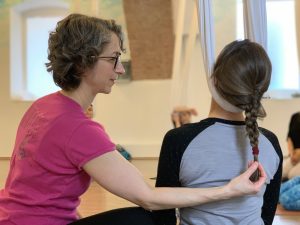
 I’ve begun teaching in-person guided yoga classes again, and have been lucky to meet a wide variety of students. Because these classes are limited to just one to three people, I’m able to really get to know each person. I’ve been enjoying the ability to tailor the positions we practice to each student’s goals and limitations. Even though I’m calling them small group classes, they are, in many ways, more like shared privates.
In larger group classes, yoga teachers frequently offer alternative positions or modifications to accommodate a range of bodies and personalities. But when there are many students to attend to, there is only so much customization that can be offered to each person, in each pose. As a result, some of the students I’ve been working with are encountering variations they’ve never seen before. From what I can tell, this has been both exhilarating for them and somewhat surprisingly, a little unsettling.
Last week, after I suggested that one student twist in the opposite direction from the standard approach so that her spine could rotate more fully, she expressed confusion. Evidently, a previous teacher had told her that yoga poses are done only in specific ways. She adopted her best stern school-marm voice when sharing her previous teacher’s words: “Because that is the way it’s done.” I suppose if my suggestions are different from “the way it’s done,” they could appear incorrect.
I wasn’t quite sure how to respond.
On the one hand, I understand and even agree with that perspective. In group classes, there is value in letting go of personal preference and moving together as a cohesive unit. I’ve often heard my teacher, Dharma Mittra, encourage us to practice Sun Salutations with the exact same timing, “as if you are in a parade.” For many, this means moving slightly faster or slower than what feels natural. It can feel restrictive at first, but over time practicing this way cultivates non-attachment, discipline, and connection to the group – all of which help us move beyond the ego-driven mind. When teaching a group, it is often appropriate to guide students to move in the same way, making exceptions for injuries.
That being said, consistently practicing asanas in only one way can lead to the belief that there is a single “correct” form. From that perspective, there is little room for nuance and the possibility that two seemingly opposite approaches might both be valid, depending on the context.
This is where private and shared private classes offer something different. In a more individualized setting, the practice can be shaped around a student’s unique history, perspective, and physical and energetic makeup. Progress often happens more quickly in this environment, not because one is doing more, but because what is being done is more appropriate.
Group classes teach us how to move together. Personalized instruction teaches us how to move authentically. Both have their place. But when students are given the space to explore beyond the way it’s usually done, they begin to develop something far more valuable than perfect form.
They begin to develop discernment.
